
SPEED
EASY NAVIGATION
QUICK RESPONSES
DIRECT SHIPMENTS
GLOBAL SUPPORT
EXCELLENCE
QUALITY SUPPLIERS
PROMPT SERVICE
SATISFACTION IS
#1 PRIORITY
ECONOMICS
LOWEST PRICES
FREE FREIGHT
QUICK DELIVERIES
KNOWLEDGE
FACTORY TRAINED
OTJ EXPERIENCE
ENGINEERING SUPPORT
Depth Filtration vs. Surface Filtration
Choose the Right Filter Media for Better Performance and Lower Cost
There are many types of filter cartridges and bags. The first step in selecting the right one is often determining whether you need depth filtration or surface filtration.
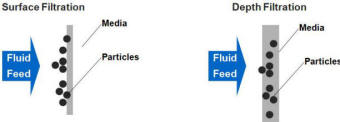
Surface Filtration
Surface filtration retains particles mostly on the surface of the media. As particles accumulate, they form a "cake layer" that increases filtration efficiency over time.
This type of media is typically nominally rated (initially 60–70% efficient at the target micron size). As the cake builds, efficiency can approach 100%. Nominally rated surface media is the most common and least expensive option. The amount of surface area directly affects solids loading capacity and pressure drop.
Depth Filtration
Depth filtration uses thicker media or multiple layers that create a tortuous path for fluid to travel through. Larger particles are typically captured near the surface while progressively finer particles are trapped deeper in the media.
Many depth filtration products are rated at 95–99% efficiency and do not rely on a filter cake for performance. While depth media usually lasts longer than surface media, it also costs more.
Key Differences & Considerations
Surface Filtration:
• Particles retained primarily on the surface
• Cake layer improves efficiency over time
• Lower initial cost
• Good for applications where a filter cake is acceptable
Depth Filtration:
• Particles captured throughout the thickness of the media
• Higher efficiency (often 95–99%) without relying on cake
• Longer service life in many applications
• Higher upfront cost but potentially lower total cost of ownership
There is no universal industry standard for "nominally" rated media. Each manufacturer defines it differently. If one filter bag or cartridge is significantly more expensive than another, it is often due to thicker or more complex depth media.
When calculating return on investment, consider not only media cost but also incoming freight, disposal, and labor costs associated with change-outs. Depth filtration media often reduces the frequency of replacements.
We have written a detailed article explaining filtration efficiency nomenclature that provides a technical breakdown of nominal vs absolute ratings.
Call 908.362.9981 — speak with a filtration specialist
or Submit a Filter Bag Inquiry for fast recommendations and pricing.